An optimized fast-food counter is useless if the space in front of it is chaotic. Customer flow dictates the psychological perception of wait times; a logically managed queue feels significantly shorter than an unmanaged crowd of equal size.
Separation of Zones
The most critical error in traditional counter layouts is conflating the transaction area with the fulfillment area. If customers order their food and stand in the same footprint to wait for it, they block the entry path for subsequent customers, grinding throughput to a halt.
Modern layouts mandate strict lateral separation. The counter must visually and physically guide patrons from an "Order Zone" to a distinct "Pickup Zone." This is achieved through several design interventions:
- Overhead Wayfinding: Hanging signage or digital displays that clearly mark "Order Here" and "Collect Here," establishing visual anchors before the customer even joins the line.
- Counter Topography: Lowering or raising the physical height of the counter at the pickup zone breaks the visual continuity, signaling a change in function.
- Material Changes: Altering the flooring material or the cladding on the front of the counter between the two zones serves as a subconscious boundary line.
The Mechanics of Queuing Layouts
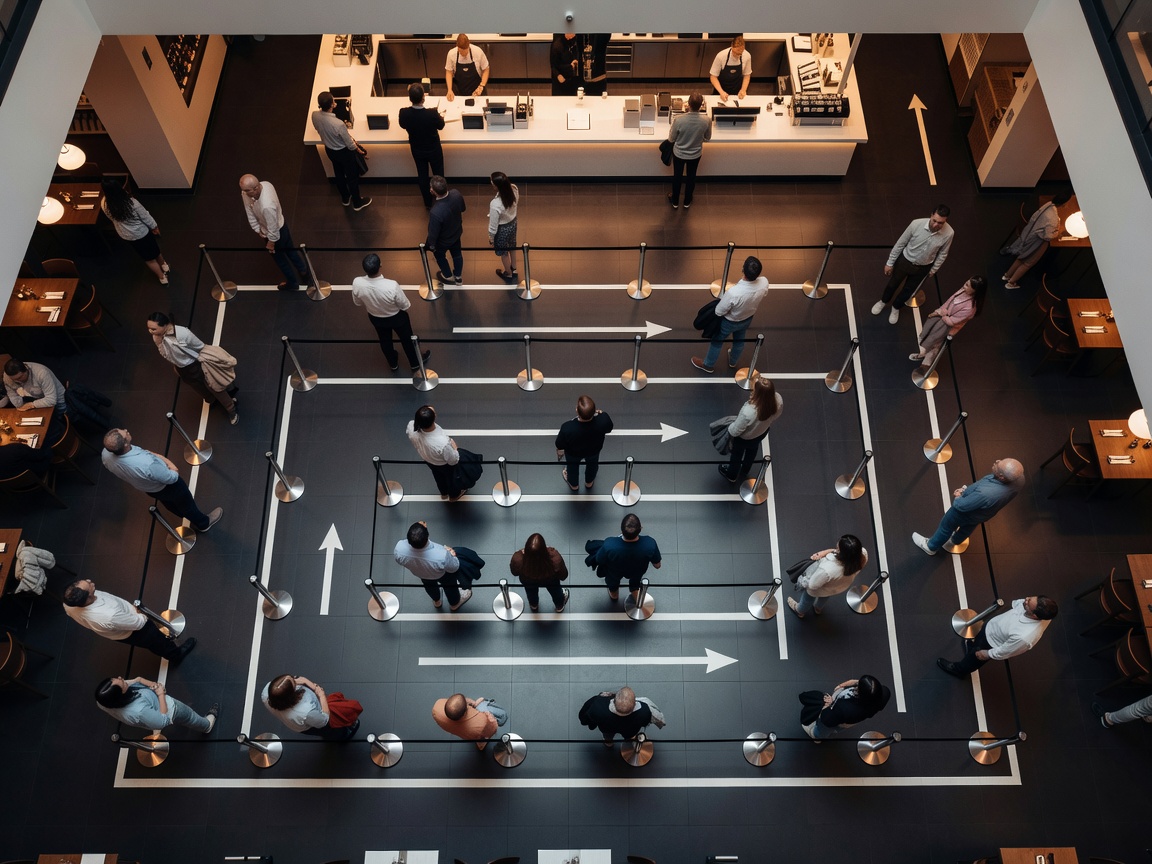
Directing the physical line requires physical barriers. Unstructured queuing (where patrons simply form informal lines behind registers) leads to "line gambling," where customers stress over picking the fastest cashier.
The serpentine queue is the standard for high-volume environments. A single, winding line feeds into multiple available registers. While a serpentine line often looks longer to an incoming patron, studies show it moves faster on average and eliminates the anxiety of choosing the "wrong" line. Managing this requires rigid stanchions or half-walls built permanently into the floor plan.
Menu Board Positioning
Customer flow is intrinsically linked to decision-making time. If a customer cannot read the menu until they reach the front of the line, transaction time doubles. Digital menu boards must be angled and scaled to be legible from the very back of the serpentine queue.
Furthermore, deploying secondary pre-sell boards—smaller, simplified menus showcasing limited-time offers or combo meals—at the entrance of the queue prime the customer's decision-making process before they approach the POS terminal.
Handling Digital and Delivery Orders
The rise of mobile ordering and third-party delivery services introduces a new vector of foot traffic. Delivery drivers and mobile-order customers have no intention of queuing or ordering; they require immediate access to fulfillment.
A secondary pickup module, entirely decoupled from the main queue, is essential. Dedicated shelving units facing the customer floor, clearly alphabetized or numbered, allow for frictionless self-service collection without crossing paths with patrons waiting to order.